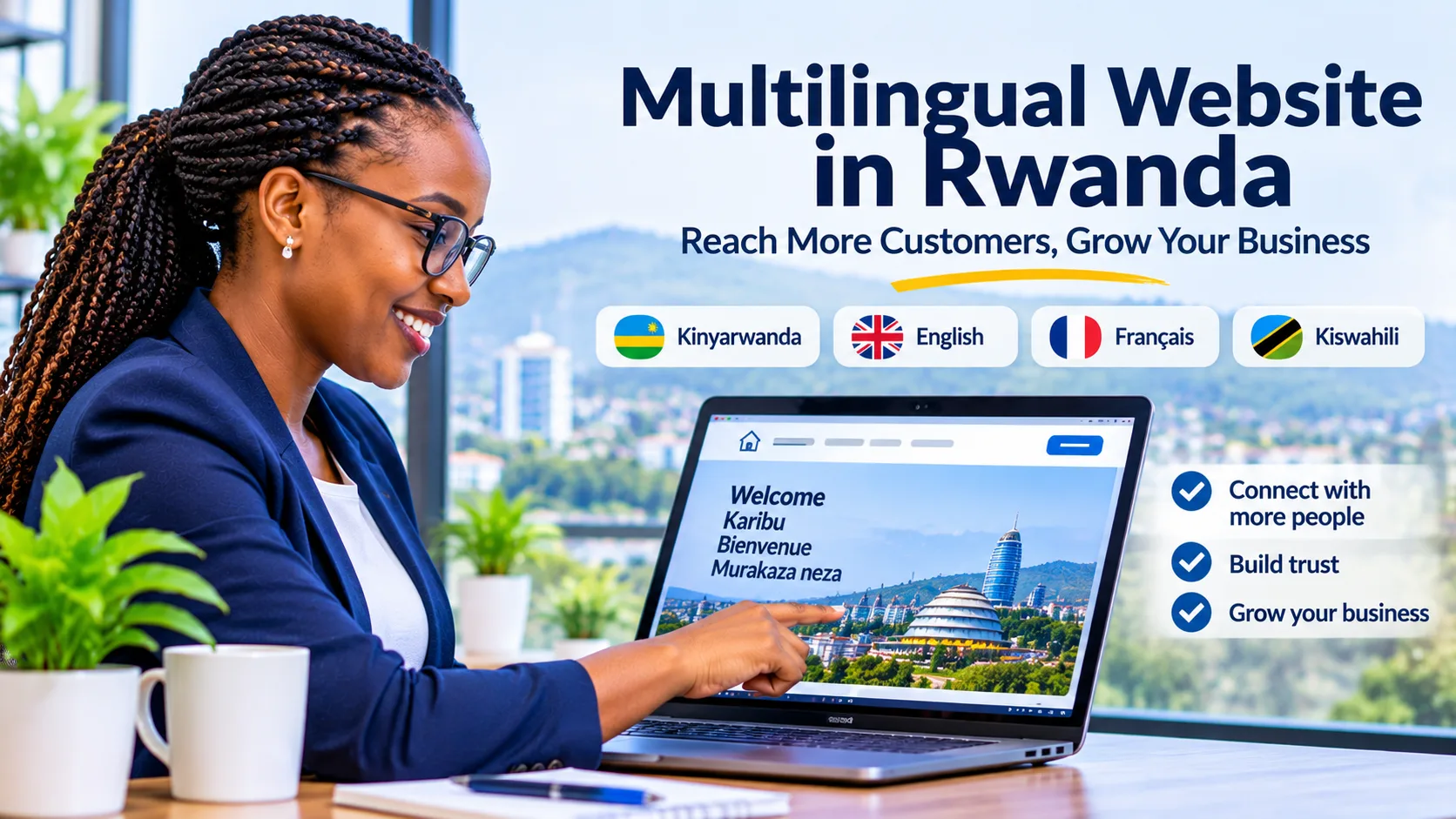
A business website should do more than display your company name, services and contact details. It should help potential customers understand what you offer, feel confident about your business and know how to take the next step.
One important way to improve that experience is by making your website available in more than one language.
In Rwanda, businesses serve customers with different language preferences. Some visitors may be more comfortable reading in Kinyarwanda, while others may prefer English, French or Kiswahili. A website that communicates clearly with these different audiences can create a more welcoming and accessible online experience.
For businesses targeting customers beyond Rwanda, multilingual content can also help communicate with international visitors.
1. Rwanda has a multilingual audience
Rwanda's national language is Kinyarwanda, and the country's other official languages include English, French and Kiswahili. This creates opportunities for businesses to communicate with different audiences using the languages they understand best.
Government of Rwanda
The 2022 Population and Housing Census literacy report also highlights why language choice matters. Among people aged 15 and above, approximately 54% were reported as literate in Kinyarwanda only, while 14.1% were literate in both Kinyarwanda and English.
Rwanda National Institute of Statistics
These figures do not mean every business needs four website translations. They show why businesses should think carefully about the language preferences of the people they want to reach.
2. Make your products and services easier to understand
Imagine a customer visiting a construction company's website. The customer wants to understand the company's services, see completed projects and request a quotation.
If the information is presented in a language the visitor finds difficult, they may leave without making an enquiry.
A multilingual website gives visitors more opportunities to understand:
What your business does.
Which products or services you provide.
How your services work.
Your prices or quotation process, where applicable.
How to contact your team.
The goal is not simply to translate words. It is to make important business information clear.
3. Build trust with different customer groups
People are more likely to engage with information they can understand.
When a business takes the time to communicate in the languages its customers prefer, it demonstrates consideration and professionalism.
For example:
A hotel can explain room types, facilities, reservations and policies in different languages.
A real estate company can present available properties, rental information and sales services clearly.
A school can explain its programmes, admission process and requirements.
An e-commerce business can make product descriptions and purchasing instructions easier to follow.
A well-translated website can make your business feel more accessible to people who might otherwise struggle to understand your offer.
4. Reach customers beyond your immediate market
A business in Rwanda may serve local customers, international visitors, regional partners or organisations operating across borders.
A multilingual website can help communicate with these audiences without requiring every visitor to rely on a third-party translation tool.
For example, a tourism company may choose English and French alongside Kinyarwanda. A business targeting customers in regional markets may consider Kiswahili, depending on its audience.
The right language combination depends on your business model, target locations and customer research. Adding languages without a clear audience or a plan to maintain the translations can create unnecessary work.
5. Support your international and local SEO strategy
Search engines need to understand which language a page uses and which audience it is intended for.
A properly structured multilingual website can help search engines discover and serve the appropriate language version of a page.
A good multilingual SEO setup may include:
Separate URLs for each language version.
Accurate page titles and meta descriptions in each language.
Translated headings, page content and image descriptions where relevant.
Language navigation that is easy for visitors to use.
Correct language and regional annotations, such as
hreflang, where appropriate.Links between equivalent pages in different languages.
For example, a company might organise its website using a structure such as:
example.com/en/— Englishexample.com/rw/— Kinyarwandaexample.com/fr/— French
This is an example of one possible URL structure, not a requirement for every website.
Simply translating a page does not guarantee higher Google rankings. Each language version still needs useful content, a technically sound structure and an SEO strategy that matches the audience.
6. Which languages should your business choose?
Do not choose languages only because they are widely used or officially recognised. Start with your customers.
Consider the following questions:
Where are most of your customers located?
Which languages do they prefer when making business decisions?
Are you targeting local customers, international visitors or both?
Which languages can your team maintain accurately?
Do your products, services or legal documents require careful translation?
For many businesses operating mainly in Rwanda, Kinyarwanda and English may be a practical starting point. Other businesses may benefit from French or Kiswahili, depending on their target markets.
It is better to maintain two accurate language versions than to publish four incomplete or poorly translated versions.
7. Avoid common multilingual website mistakes
Adding multiple languages requires planning. Poor implementation can confuse visitors and make your website harder to maintain.
Here are mistakes to avoid:
Using automatic translation without review
Automatic translation tools can help with an initial draft, but they may misunderstand technical terms, business expressions or the intended meaning. Important pages should be reviewed by someone proficient in the target language.
Translating only the homepage
Visitors should not be forced to switch languages every time they open another page. Important pages, including services, contact information and frequently asked questions, should have consistent language versions.
Leaving buttons and forms untranslated
Navigation menus, booking forms, enquiry buttons, error messages and confirmation messages are part of the user experience. They should also be translated.
Ignoring mobile users
Many customers access business websites from mobile phones. Language selectors, navigation and translated content should work comfortably on smaller screens.
Failing to update every language version
When your business changes its phone number, prices, services or policies, the relevant information should be updated across all language versions.
Using unclear language-selection options
Visitors should be able to identify their preferred language easily. A visible language selector is usually more useful than automatically redirecting people based only on their location.
8. What should a business do before building a multilingual website?
Before development begins, prepare a simple language plan.
Identify your main customer groups.
Select the languages that match those audiences.
Prepare accurate content for each language.
Decide how the language selector will work.
Plan the website's URL structure.
Identify who will review and update translations.
Include multilingual SEO in the technical setup.
Test all pages, forms and navigation on mobile and desktop.
This preparation helps prevent expensive redesigns and inconsistent content after launch.
9. How BrightLink Technologies Ltd can help
At BrightLink Technologies Ltd, we design and develop professional websites for businesses and organisations in Rwanda and beyond.
A business website should reflect the organisation's identity, communicate its services clearly and make it easy for customers to take action.
Our website development services include responsive design, SEO-ready website structures and content that businesses can update. For organisations that need additional digital support, we also provide software development, digital marketing and IT support.
Whether you need a corporate website, hotel website, real estate website or e-commerce platform, we can help you plan a website that supports your business goals and target audience.
Explore our services:
Conclusion: Speak your customers' language
Your website is an important communication channel between your business and potential customers.
A multilingual website can help people understand your services, improve the experience for different customer groups and support your efforts to reach new markets.
However, success depends on choosing the right languages, providing accurate translations and maintaining a consistent experience across the entire website.
If your business wants to reach more people in Rwanda and beyond, it may be time to consider a website that speaks to your customers in the languages they understand.
Ready to build a professional multilingual website?
Contact BrightLink Technologies Ltd to discuss your website project.
Website: brightlinkltd.com
Email: info@brightlinkltd.com
Call: +250 782 567 921 / +250 795 263 269
Location: Kigali, Rwanda