

A website can attract visitors, but do you know what those visitors actually do when they arrive?
Many businesses invest in website development and digital marketing without regularly checking whether their websites are helping them achieve their goals. They may know how many people visit their website, but not which pages attract attention, where visitors come from or whether people contact the business.
This is where website analytics becomes important.
Today's article explains how businesses can use website data to make better decisions, improve their websites and understand the results of their online activities.
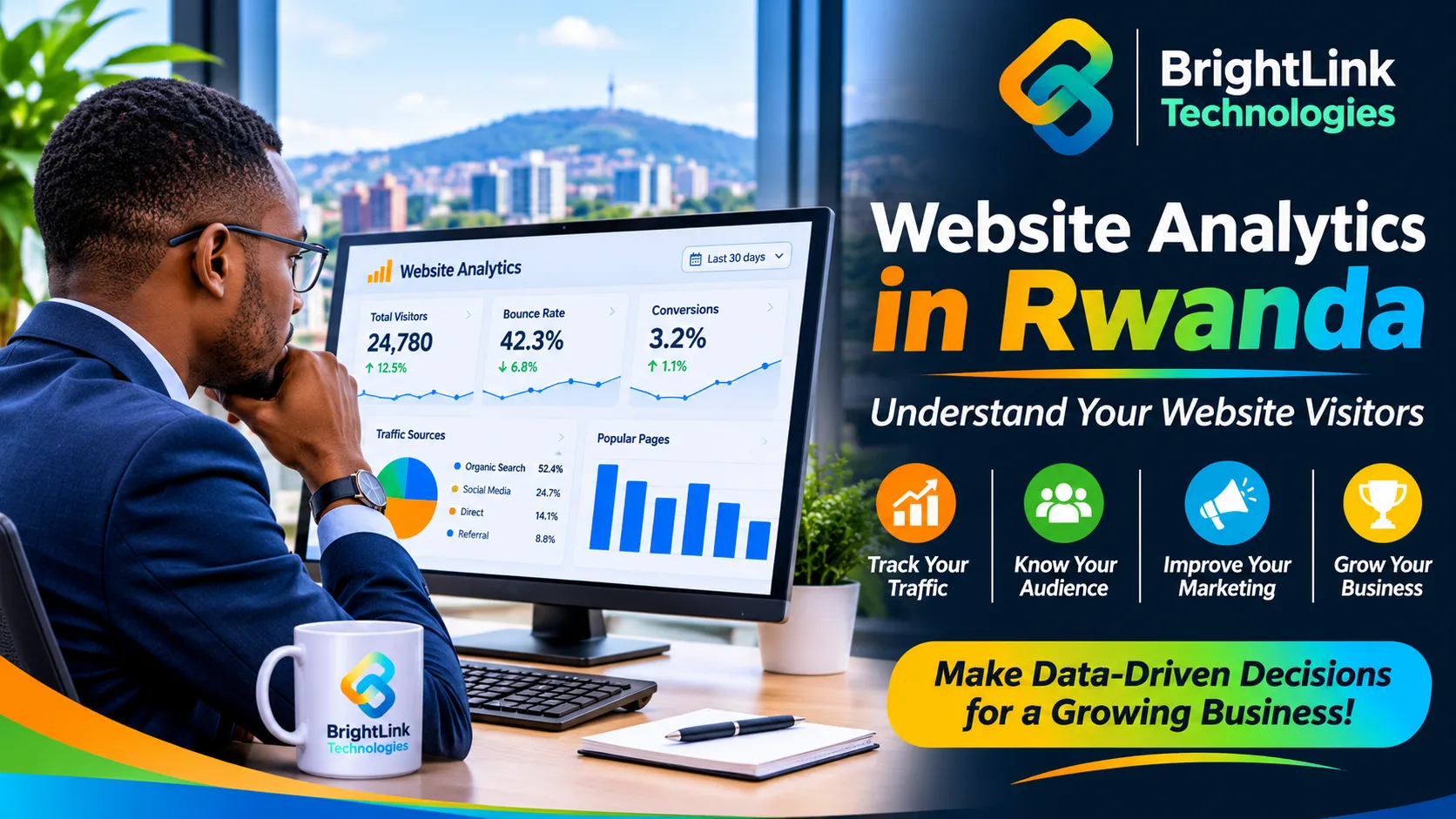
Website Analytics for Businesses in Rwanda: How to Understand Your Website Visitors
Your business website is more than an online presentation. It is also a source of information about how potential customers interact with your business.
Every visit can provide useful insights. Visitors may explore your services, read your articles, view products, submit enquiries or leave without taking action.
Website analytics helps you understand these activities.
For businesses in Rwanda, whether operating in retail, hospitality, construction, real estate, education or professional services, understanding website performance can help identify opportunities and areas that need improvement.
1. What is website analytics?
Website analytics is the process of collecting and analysing information about how people use your website.
It can help answer questions such as:
How many people visit your website?
Which pages do they visit most?
Where do visitors come from?
Which devices do they use?
How long do they engage with your content?
Which actions do they complete?
Which pages may need improvement?
Instead of making website decisions based only on assumptions, your business can use available data to understand visitor behaviour.
For example, if many people visit your services page but very few submit enquiries, you may need to review the page content, contact options or enquiry process.
2. Understand where your website visitors come from
Not every website visitor discovers your business in the same way.
Some may find you through Google, while others arrive through social media, online advertisements, links from other websites or by entering your website address directly.
Understanding these sources can help you evaluate your marketing activities.
Consider a business that promotes its services on Facebook, LinkedIn and Google.
By reviewing website traffic sources, the business may discover that one channel generates many visits while another brings fewer visitors but more serious enquiries.
This information can help guide future marketing decisions.
3. Identify which pages attract the most attention
Some pages on your website may receive more visits than others.
For example, a construction company may discover that visitors frequently view its projects and portfolio pages. A hotel may find that its accommodation pages attract more attention than its homepage.
This information can help you understand what potential customers want to learn about your business.
Review:
Most visited pages.
Pages where visitors first arrive.
Pages that receive little attention.
Content that encourages visitors to explore other pages.
Pages that need clearer information or better navigation.
Google Analytics 4 provides landing-page and engagement reports that can help with this analysis.
Analytics Help+1
4. Measure actions that matter to your business
Website traffic is useful, but the number of visitors alone does not tell you whether your website is generating business opportunities.
You should also measure meaningful actions.
Depending on your business, these may include:
Contact form submissions.
Clicks on telephone numbers.
WhatsApp enquiry clicks.
Appointment requests.
Booking submissions.
Product purchases.
Newsletter registrations.
Requests for quotations.
For example, if 500 people visit your website in a month and 20 submit enquiries, you can investigate which pages and traffic sources contributed to those enquiries.
In Google Analytics 4, important actions can be configured as key events, allowing businesses to monitor activities that matter to their objectives.
Analytics Help+1
Remember that a button click is not necessarily a completed sale. Your tracking should distinguish between someone starting an action and successfully completing it.
5. Understand the devices visitors use
Your website may look excellent on a desktop computer but provide a poor experience on a smartphone.
Analytics can help you understand the devices and technologies visitors use to access your website.
This information is useful when deciding where to focus website improvements.
For example:
If most visitors use smartphones, prioritise mobile navigation and readable content.
If visitors frequently use tablets, test page layouts on tablet screens.
If a particular browser experiences problems, investigate compatibility.
If forms are difficult to complete on mobile, simplify their layout.
A responsive website should work well across different screen sizes, but testing with real devices remains important.
6. Use Google Analytics and Google Search Console together
Two useful tools for understanding website performance are Google Analytics 4 and Google Search Console.
They provide different types of information.
Google Analytics 4 (GA4) helps you understand what visitors do after arriving on your website. You can analyse traffic sources, page activity, engagement and important actions.
Google Search Console helps you understand how your website performs in Google Search. It provides information about search impressions, clicks, queries and the pages appearing in search results.
Using both tools gives your business a broader understanding of its online presence.
For example, Search Console may show that a service page appears frequently in Google results but receives relatively few clicks. Analytics may then help you understand what visitors do after arriving on that page.
Google explains how these tools can be used together for SEO analysis.
Google for Developers+1
Useful official resources:
7. Do not focus on traffic numbers alone
A common mistake is judging website success only by the number of visitors.
Imagine two businesses:
Business A receives 2,000 website visits but gets very few enquiries.
Business B receives 600 visits and generates 35 relevant enquiries.
Although Business A has more traffic, Business B may be attracting visitors who are more interested in its services.
These are illustrative figures, not industry benchmarks. The important lesson is that traffic should be evaluated alongside business outcomes.
Depending on your objectives, consider monitoring:
Metric | What it helps you understand |
|---|---|
Website users | How many distinct visitors access your website |
Sessions | How often people visit |
Traffic sources | Where visitors come from |
Landing pages | Which pages visitors enter through |
Engagement | How visitors interact with your content |
Key events | Whether visitors complete important actions |
Sales or enquiries | Whether the website contributes to business objectives |
The most useful metrics are those connected to your business goals.
8. Review your website data regularly
Website analytics should not be something you check only once when your website is launched.
Create a simple reporting routine.
Weekly review
Check for unusual changes in traffic.
Review new enquiries and purchases.
Identify pages that may have technical problems.
Monitor important website actions.
Monthly review
Compare traffic sources.
Review the most popular pages.
Evaluate marketing campaign performance.
Identify pages that need improvement.
Review completed enquiries or sales.
Quarterly review
Compare performance against business goals.
Identify new customer behaviour patterns.
Review your content strategy.
Plan website improvements.
Regular reviews help turn website data into practical business decisions.
9. Protect visitor privacy when collecting website data
Website analytics involves collecting information about website usage. Businesses should therefore consider privacy when setting up tracking tools.
Before collecting analytics data:
Explain relevant data collection in an appropriate privacy notice.
Collect only information necessary for your purposes.
Avoid placing personal or sensitive information in analytics event names, URLs or tracking parameters.
Configure consent and tracking technologies appropriately for applicable requirements.
Limit access to analytics accounts to authorised people.
Review the privacy requirements relevant to your business and visitors.
Analytics should help you understand website performance without unnecessarily exposing customer information.
10. Turn website insights into improvements
Collecting data is only useful when you act on what you learn.
For example:
Situation: Many visitors view your services page but do not contact your business.
Possible improvement: Make the service descriptions clearer, add relevant project examples and improve the visibility of your contact options.
Situation: Visitors frequently leave a particular product page.
Possible improvement: Review the product photographs, descriptions, pricing information and page performance.
Situation: Your social media campaigns generate visits but very few enquiries.
Possible improvement: Check whether the advertisement matches the landing page and whether visitors can easily complete the next step.
The objective is not to change everything at once. Identify a problem, make a reasonable improvement and review the results.
How BrightLink Technologies Ltd can help
At BrightLink Technologies Ltd, we believe a business website should support real business objectives.
A professional website should not only look attractive. It should also provide a useful experience, communicate services clearly and make it easy for customers to take action.
Our services include:
Website design and development
We develop responsive websites for companies, hotels, real estate businesses, organisations and other industries.
SEO and digital marketing
We help businesses improve their online visibility and develop strategies to attract relevant audiences.
Custom software development
We build business systems that help organisations manage operations and information more effectively.
Website performance and analytics setup
We can help businesses plan website tracking, configure relevant analytics tools and identify meaningful performance indicators.
Whether you are launching a new website or improving an existing one, we can help you understand what your digital presence needs to achieve.
Explore BrightLink Technologies Ltd to learn more.
Conclusion: Make better decisions with website data
Your website can tell you much more than how many people visit it.
With the right analytics setup, your business can understand where visitors come from, what they are interested in and which actions they complete.
This information can help you improve website content, strengthen marketing campaigns and make more informed decisions about your digital strategy.
Do not simply ask how many people visited your website this month. Ask what those visitors did and whether your website helped your business achieve its goals.
Want to understand how your website is performing?
Contact BrightLink Technologies Ltd for professional website development and digital solutions.
Website: brightlinkltd.com
Email: brighttlink@gmail.com
Phone: +250 782 567 921 / +250 795 263 269
Location: Kigali, Rwanda